Services Offered
Massage Assessment CE Workshops Live
Massage Assessment CE Online
Massage Therapy Appointments
Instructors/Author BIO
Mark Senzig, BCTMB, MMT, CMT, National Board-Certified (BCTMB)
NCBTMB - CE Approved Provider
#1000799
My work combines evidence-based biomechanics with hands-on clinical practice. I began exploring Eastern approaches to somatic health at the Acupressure Institute in Berkeley (2003). In 2007, I graduated from the National Holistic Institute’s Professional Massage Program in Petaluma/Santa Rosa, earning the title of Massage Therapist of the Year for Northern California.
I’ve run a thriving manual therapy practice since 2004. In 2011, I focused my practice on orthopedic and movement-based techniques, including Erik Dalton’s Myoskeletal 210 Program. Today, I mentor and teach in Benicia and across Northern California, guiding therapists in advanced assessment and treatment strategies.
Professional milestones and education:
National Board Certification (BCTMB #824029), 2018
Developer of National Certification Board–approved course material, 2016–present
Approved Continuing-Education Provider, 2021
Course catalog expanded in 2025 to include 30 online CEUs and 17 live CEUs
Teaching and publications:
Three eBooks:
A Massage Therapist’s Approach for Chronic Back-SI Joint & Hip Pain. A Massage Therapist’s Approach for Chronic Foot & Ankle Pain.
A Massage Therapist’s Approach for Chronic Neck–TMJD Pain
Amazon book: Breaking Hip Pain Patterns (10,000 words, 85 pages)
Amazon audiobook: Breaking Hip Pain Patterns (1 hour)
YouTube channel featuring hands-on demonstrations
Digital training video: Massage Therapy for Back Pain (Apple Store)
Three Udemy courses serving an international student body of 1,350
Social presence: 6,000 followers on Facebook, 2,500 on LinkedIn, 700 on Instagram
My online home is marksenzig.com, the hub for course registration, video demonstrations, and CE resources.
Massage Assessment CE Workshops
Mark’s online and live courses are grounded in a clear, science-driven promise: when you understand alignment, load, and how tissue and the nervous system respond to skilled touch, you can help clients move with less pain and greater efficiency.
Across every class, he teaches a pragmatic, repeatable method that begins with assessment and ends with measurable change. You learn to see how a body organizes itself in gravity, identify the primary restrictor that is shaping the pattern, apply precise manual inputs at the right dosage, integrate those inputs with targeted activation, and confirm the impact through a test–treat–retest loop. The result is structural rebalancing that lasts—segments stack and share load more evenly, protective tone-downshifts, and movement options expand in ways clients can feel and verify.
The foundation of the curriculum is structural rebalancing, which, in practice, means restoring how regions relate to one another so that no single area is forced to do too much. Rather than chasing symptoms, you learn to map global patterns and follow cause-and-effect across the kinetic chain: how foot mechanics cascade into knee and hip stress, how pelvic orientation shapes lumbar behavior, how thoracic stiffness drives cervical strain and jaw tension, and how scapular organization echoes through the glenohumeral joint and rib cage.
Throughout, Mark draws on contemporary pain science and motor-control research alongside classic orthopedic reasoning. Manual techniques are framed through a neuro-mechanical lens, where touch alters afferent input, reduces protective tone, and invites new movement options. Graded loading and movement, then “lock in” those options so they hold up outside the clinic. Sessions are artful, but they are also accountable: you track range-of-motion changes, load-tolerance shifts, and symptom modulation so you know when the needle is moving.
The first of the four online courses focuses on chronic back, SI joint, and hip pain. It opens by clarifying how pelvic orientation, sacral mechanics, and functional leg-length patterns influence lumbar load. You learn to distinguish the true driver in a given presentation—whether the primary issue is capsular restriction, protective myofascial tone, or a motor-control deficit—so your manual work lands where it will have the most leverage.
Assessment is straightforward and practical, using seated and standing landmark checks, pelvic shear tests, hip rotation balance, and simple gait observations to reveal how the lumbopelvic complex is managing load. The manual component integrates myofascial release to the thoracolumbar fascia, decompressive holds that offload lumbar facets, and precise pin-and-lengthen strategies for iliacus, psoas, quadratus lumborum, and the deep lateral hip, all taught within the scope of massage practice.
As sympathetic tone downshifts and soft tissue yields, you layer in gentle joint play and traction to improve lumbopelvic mobility, then immediately retest: provocation signs at the SI region, segmental lumbar flexion and extension, and stance tolerance are compared before and after to confirm that the intervention mattered.
Movement integration focuses on posterior chain support, breath-led core strategies that respect pressure management, hip hinging, and gait drills that reinforce newly available motion. The through line is simple and compelling: by reducing nociceptive drive and redistributing load, you expand movement options; by loading those options right away, you promote motor learning and durability.
A complementary course addresses the foot and ankle, where small mechanical gains often lead to large global changes. Instruction begins with the tripod foot and subtalar neutral as reference points, then moves into clear measures of dorsiflexion and ankle rocker that help you predict how well the knee and hip can stack above the foot.
Palpation and treatment centers on the usual suspects—gastrocnemius and soleus, tibialis posterior, the peroneals, and flexor hallucis longus—using cross-fiber techniques and pin-and-stretch to target densified or overactive tissue without provoking flare-ups. When mobility is the limiter, you learn safe joint play for the talocrural and midfoot joints, with careful guidance on vectors and dosage so mobility gains are specific and clinically relevant.
When neural mechanosensitivity is part of the picture, tibial and sural nerve-glide variations offer a way to reduce sensitivity and improve neural mobility, always monitored with symptom severity and irritability in mind. Every manual input is followed by activation: short-foot drills to reinforce a stable arch, foot intrinsic exercises, and simple step-down and balance progressions that re-establish an efficient ankle strategy in gait. You track change with before-and-after measures of dorsiflexion, midfoot mobility, and stance control, and you connect those local gains to more efficient knees, hips, and lower backs—a true ground-up approach.
The third course focuses on arm and shoulder pain and the often-overlooked relationship among the scapulothoracic interface, the glenohumeral joint, and the rib cage. The course begins with an assessment that clarifies scapular position and motion, the balance of internal and external rotation at the shoulder, and how first-rib and upper-thoracic stiffness can limit clean elevation.
You use Apley’s reach and simple functional tasks to reveal where the pattern breaks down, and you check for pec and lat dominance that can drag the shoulder forward and down. Manual work targets pec minor and major, latissimus dorsi, subscapularis, and the posterior cuff—especially infraspinatus and teres minor—along with attention to the biceps long head and the posterior capsule when end-feels suggest capsular limitation.
Decompressive holds and soft-tissue normalization are taught alongside gentle first-rib and upper-thoracic mobilizations within massage scope, and nerve glides for median, ulnar, and radial pathways are introduced when mechanosensitivity limits available range. Integration focuses on restoring upward-rotation sequencing, waking up serratus anterior and the lower trapezius, and balancing cuff activation so the humeral head stays centered through motion. As in every course, you verify impact by retesting overhead tolerance, rotational range, and symptom reproduction during relevant functional tasks, turning your session into a guided experiment that shows you what truly matters for that client.
The fourth course tackles neck and TMJD pain, bringing together cranio-cervical stacking, thoracic contribution, and jaw mechanics in a cohesive map. It starts with a clinical overview of forward-head patterns, thoracic extension deficits, and jaw-tracking asymmetries, then moves into precise manual sequences that meet the nervous system where it is.
Suboccipital decompression sets the tone by modulating protective guarding at the base of the skull. Myofascial work targets sternocleidomastoid, scalenes, upper trapezius, and levator scapulae to normalize tone and unstick the soft tissues that anchor dysfunctional patterns.
As tolerance improves, you add gentle first-rib work and segmental cervical mobilizations within scope, and you incorporate brachial plexus glides when neural mechanosensitivity is part of the limitation. For TMJD presentations, intra- and extra-oral techniques address masseter, temporalis, and pterygoids, with scrupulous consent and hygiene protocols. Integration is constant: deep neck flexor facilitation, rib mobility through breathing drills, and tongue- and jaw-alignment exercises retrain timing so changes consolidate in daily life. At each step, you recheck neck rotation, side-bending, mouth opening, and symptom response, using those tests to choose your next best move.
All four online classes deliver this method through clear, high-definition demonstration and multi-angle camera views that let you see hand placements, vectors, and sequencing in real time. On-screen anatomy overlays keep orientation clear, while printable protocols provide dosing parameters and time-under-tension guidelines you can reference at the table.
Each module includes clinical decision trees to help you choose where to start, how to progress, and when to pivot, so you can adapt quickly to different client presentations. The format is intentionally lab-like: you move from assessment to manual work to corrective exercise and retesting in a repeatable flow that you can take directly into practice. Safety is woven throughout, with attention to scope-appropriate care, contraindications, referral criteria, and client-centered communication that builds trust without alarming language.
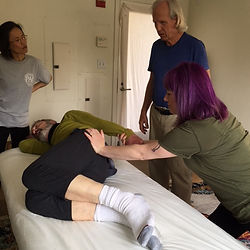
The eight-hour live CE course braids all four regions into a single, whole-body intensive that sharpens your eye and your hands. You learn to map patterns from the ground to the spine, linking foot mechanics to knee and hip load, pelvic orientation to lumbar behavior, thoracic stiffness to cervical strain and jaw tension, and scapular organization to shoulder function. The live format is where the irreplaceable feel component comes alive: Mark works with you one-on-one to refine hand placements, calibrate pressure and vectors, and match your dosage to client irritability and nervous-system response in real time. You practice prioritizing the single driver most likely to shift the global pattern, then sequence two or three high-yield interventions that change how the whole system organizes.
Immediately after manual inputs, you build durability with well-dosed activation and simple movement drills that “lock in” new options. Quick regional and global retests close the loop so you can see, on the spot, whether what you did mattered—and if not, what to try next. Live labs run in Benicia and across Northern California mirror the same alignment-first framework used in Mark’s practice since 2004 and serve as a practical capstone to the four-course online series. Together, the catalog currently offers 30 online CEUs and 17 live CEUs.
To help you systematize your thinking, Mark’s materials emphasize classification and dosage rather than rote routines. His book and audiobook, Breaking Hip Pain Patterns, along with related coursework, give you a unifying language for common hip–pelvis presentations. You learn to sort patterns by capsular signs, myofascial findings, and motor-control behaviors, then match those patterns with region-specific manual sequences and corrective activation. Dosage—how much pressure, in what vector, for how long—receives special attention, as does outcome tracking that honors both objective change and client-reported function. The same logic extends across the body: if a capsular end-feel dominates, you emphasize mobilization and decompressive holds; if tone is protective and irritable, you lead with softer myofascial and positional release work before loading; if motor control is the missing link, you weave brief, well-dosed activation into the session so new options stick.
Beyond the core courses, Mark supports learning with resources designed to make complex ideas usable at the table. Three regional eBooks—on chronic Back–SI Joint and Hip Pain, Chronic Foot and Ankle Pain, and Chronic Neck–TMJD Pain—translate biomechanics into step-by-step protocols. Digital training videos, grouped under Massage Therapist’s Approach, distill the full-session flow in prone, side-lying, and supine so you can see how each intervention builds on the previous one. On-screen timers and cueing help you internalize pacing and dosage, two variables strongly linked to outcomes in mechanotherapy and motor-learning research. A YouTube channel provides demonstrations you can revisit anytime, and Udemy courses have reached an international audience, extending access to therapists around the world. Across every platform, the message is consistent: structural rebalancing is not a mystery. It is the product of good assessment, skillful touch, intelligent loading, and honest retesting.
Mark’s background informs a teaching style that is rigorous yet accessible. He began exploring Eastern somatic approaches at the Acupressure Institute in Berkeley in 2003, graduated from the National Holistic Institute’s Professional Massage Program in Petaluma/Santa Rosa in 2007, and was recognized as Massage Therapist of the Year for Northern California. Since opening his practice in 2004, he has specialized in orthopedic and movement-based work. He is National Board Certified (BCTMB #824029), develops National Certification Board–approved course material, and has been an approved continuing-education provider since 2021. This experience shows up in the classroom as clinical humility and curiosity—you learn to set baselines, aim for meaningful change, and iterate if your first attempt does not move the needle. It is evidence-based practice in action, integrating research, clinical expertise, and client values to make the next best decision.
What ultimately defines these classes is the commitment to testable change and client-centered care. You are trained to ask, “Did what I just did matter?” and to let the body answer through improved range, ease, and function. You practice communicating findings in clear, non-alarming language that fosters client confidence and autonomy. You refine your hands so that less force does more work, because the nervous system responds best to inputs that are specific and well-dosed. And you leave with session templates and decision trees that organize your thinking without boxing you into rote routines. If you are ready to study a coherent, alignment-first system for manual therapy—online at your own pace or in a hands-on lab—visit marksenzig.com to register, access CE resources, and watch demonstrations that reinforce what you learn. The goal is not simply to add techniques to your toolkit, but to elevate your reasoning, your touch, and your results, so structural rebalancing becomes your default and your clients feel the difference.
Myoskeletal Alignment Therapy
Myofascial Therapy
Deep Tissue
What is a myoskeletal alignment therapist? In simple terms, it’s a hands-on practitioner who blends precise joint work with neuromuscular strategies to relieve pain, improve posture, and restore efficient movement patterns. As Mark Stuart Senzig, I practice myoskeletal alignment, myofascial therapy, Active Release Techniques (ART), and oil-free deep tissue manual therapy in every session. I work without oils or creams, using Songbird SureGrip wax to maintain firm, low-slip contact. That subtle tack allows me to engage tissue accurately, vary pressure and direction with control, and integrate movement-based techniques like ART without losing connection. The result is work that is specific, collaborative, and designed to drive lasting change.
Myoskeletal alignment focuses on the interplay between structure and function—how joint restriction drives muscular guarding, and how muscle imbalance can, in turn, distort alignment and loading. In practice, this looks like gentle joint mobilization combined with contract–relax neuromuscular cues. Instead of forcing tissue to change, I invite your nervous system to downshift protective tone. Using pain-aware pressure, graded pacing, and breath coordination, we co-create release. For example, I might position your shoulder in a small, comfortable arc and ask for a light muscle engagement before a slow exhale. Those sequences help recalibrate the system so that joints move more freely and muscles can share load correctly.
Myofascial therapy is the second pillar. Fascia is the body’s continuous connective network that wraps, links, and communicates across muscles, bones, and nerves. Repetitive postures, injuries, or stress can increase density in this network and reduce glide between layers, creating that diffuse tightness that stretching can’t quite resolve. I use slow, sustained pressure and subtle shearing across specific lines of tension. Minimal glide is key, which is why I rely on Songbird SureGrip. It gives me the right balance of traction and control so I can “catch” a fascial plane and gently encourage it to reorganize. Techniques may include cross-hand holds, long fascial lines, skin rolling, or anchored shears—always paced to your breath and comfort. As glide returns, tension balances across kinetic chains, and movement begins to feel smoother and more connected.
Oil-free deep tissue rounds out the soft-tissue foundation. “Deep” refers to the depth of engagement, not just heavy pressure. I work layer by layer, softening superficial tissues before reaching deeper structures. With SureGrip wax, I can track the tissue’s response millimeter by millimeter, follow fiber direction, and adjust vectors instantly. I use targeted techniques—pin-and-stretch, cross-fiber friction, positional release, slow compressions—to address persistent tightness and trigger points without provoking guarding. We keep communication open, using your breath and feedback to stay within a therapeutic window where change is productive and comfortable.
Into this framework, I integrate Active Release Techniques (ART) throughout every session. ART is a movement-coupled method that uses precisely applied tension while the client actively moves to lengthen or shorten the tissue under contact. It’s especially effective for fibrotic bands, adhesions, and soft-tissue sites where nerves or vessels may be mechanically irritated. ART dovetails naturally with my myoskeletal and myofascial work, because it anchors tissue with accuracy, restores slide between layers, and re-educates movement patterns in real time.
Here’s how ART weaves into the session flow:
- Movement-driven assessment: I palpate tissues while you perform small, specific motions—turning the head, abducting the arm, flexing and extending the wrist, or rotating the hip. This dynamic assessment helps pinpoint adhesions, safely reproduce familiar symptoms, and confirm the primary drivers of tension or pain. It also shows me how tissues behave under load, not just at rest.
- Pin-and-stretch application: I anchor shortened, fibrotic bands with precise tension and guide you to actively lengthen through that tissue’s line of pull. Common hotspots include scalenes, levator scapulae, pectoralis minor, quadratus lumborum (QL), hip rotators, tensor fasciae latae (TFL), and the forearm extensors. The active component allows your nervous system to participate, reducing guarding and improving carryover.
- Nerve-entrapment releases: When symptoms point toward neural irritation—numbness, tingling, burning, or pain that follows a nerve pathway—I address likely chokepoints, then follow with gentle nerve glides or flossing. Frequent sites include:
- Upper body: Brachial plexus at the scalenes and pectoralis minor; median nerve at the pronator teres; ulnar nerve at the cubital tunnel; radial nerve between the brachialis and brachioradialis.
- Lower body: Sciatic nerve at the piriformis; common peroneal nerve at the fibular head; tibial nerve under the soleus arch.
- Client-active dosing and pacing: Pressure stays slow and specific, coordinated with your breath. You help set intensity and contribute movement to avoid guarding and to reinforce neuromuscular change. This collaborative dosing keeps us in a therapeutic range that your system can integrate.
- Joint and mobility integration: After soft-tissue release, I add graded joint play or contract–relax work to restore clean motion. Examples include a first-rib glide after scalene and pectoralis minor release, humeral head centration after anterior shoulder work, or sacroiliac and lumbar gapping after piriformis and QL release. This joint follow-through consolidates gains so they show up in your everyday movement.
- Pattern-based corrections: Rather than chasing symptoms, I address regional loading habits—upper- or lower-crossed tendencies, thoracic outlet mechanics, foot and ankle pronation issues—so the changes hold. When we improve the way you organize posture and load, the body has a better chance of maintaining the new pattern.
Concrete examples of how this looks:
- Thoracic outlet relief: I may anchor the scalenes or pectoralis minor while you perform gentle cervical side-bend and rotation or scapular depression and abduction. We’ll follow with first-rib mobilization and upper-limb nerve glides to reduce neurovascular pressure and improve arm comfort.
- Lateral elbow pain: I pin the extensor wad as you flex and extend the wrist and fingers, then add a radial nerve glide and small radiohumeral joint play. This often reduces the strain that feeds “tennis elbow” patterns.
- Piriformis/sciatic irritation: I anchor the piriformis and guide you through active hip internal rotation and adduction, then follow with lumbopelvic mobilization and sciatic nerve flossing to restore space and motion along the pathway.
Why integrate ART with myoskeletal, myofascial, and deep tissue methods? Because each modality solves a different part of the puzzle. ART’s movement-coupled tension is excellent for precision and for retraining glide during function. Myofascial therapy restores broad continuity across lines and layers. Deep tissue calms focal hypertonicity and resolves trigger points. Myoskeletal alignment restores joint mechanics and neuromuscular balance. Together, they address the why behind the tightness, not just the where. For example, a perpetually tight upper trapezius may be driven by a restricted first rib, short pec minor, or breathing mechanics that overload accessory neck muscles. By freeing the chokepoints, restoring joint play, and rebalancing fascial tension, the trap can finally let go—and stay that way.
A typical session begins with a brief conversation about goals and history, then a movement and palpation assessment. I look at how your head sits over your shoulders, how your ribs move with breath, how your hips load, and how your feet manage pronation and push-off. We’ll do small motion screens—neck rotation, shoulder abduction, hip internal rotation—while I palpate to map where tissues restrict and where symptoms appear. From there, we build a shared vocabulary of pressure. Many clients like a 0–10 scale to keep us in that productive, safe range. Throughout, your breath sets the tempo. Slow inhales and longer exhales help downshift the nervous system and allow tissues to respond.
What you might feel during ART and integrated work:
- A focused, “good hurt” pressure that eases as the tissue yields.
- A sense of lengthening or sliding beneath a steady anchor.
- Replication of familiar symptoms that then diminish as the period progresses.
- Warmth, relief, or improved motion immediately after a release, especially when followed by joint play.
Who benefits from this integrated approach? Many people do:
- Desk workers with forward-head posture, rounded shoulders, intermittent numbness or tingling in the hands, and recurring neck or mid-back tension.
- Active people and athletes who manage repetitive-use patterns and want cleaner mechanics for performance and recovery.
- Individuals with persistent tightness, limited range of motion, or recurring trigger points that don’t change with stretching alone.
- Those recovering from non-acute injuries who have lingering stiffness or movement hesitancy after tissues have healed.
- Anyone seeking an effective, collaborative alternative to forceful deep tissue that can provoke guarding.
There are times when manual therapy is not appropriate. Acute injuries with active inflammation, active infections, uncontrolled hypertension, certain systemic conditions, or recent surgeries may require postponing or medical guidance. Neurological red flags—sudden weakness, loss of bowel or bladder control, severe unrelenting pain, progressive numbness—warrant immediate medical evaluation. My work does not diagnose conditions and is not a substitute for medical care; it complements it. If an issue falls outside my scope, I’ll refer you to the appropriate professional.
Clients often ask why I work without oils or creams. The reason is specificity and safety. Oil creates too much slip for the kind of precise engagement required in myofascial and ART methods. With Songbird SureGrip wax, I can anchor accurately, match the tissue’s line of pull, and guide movement without sliding off the contact. That control means less brute force, more finesse, and reduced risk of skin irritation during slow shears. It also leaves no greasy residue, so you can return to your day feeling comfortable.
A few principles shape how I work:
- Pain is information, not a goal. We may momentarily recreate a familiar symptom to confirm the driver, but our aim is to reduce threat and restore options—not to “win” through intensity.
- Less can be more. Small, accurate inputs at the right moment can create big system-wide changes.
- Breath is a bridge. Integrating the diaphragm and ribcage often unloads the neck, shoulders, and low back.
- Motion cements change. Following soft-tissue release, joint play, and active movement helps your nervous system adopt the new pattern.
- The body is a system. Addressing regional relationships—foot-to-hip, rib-to-neck, jaw-to-shoulder—makes improvements more durable.
Aftercare is simple and practical. You may feel lighter or more connected right away. Mild soreness, similar to that after a good workout, can persist for 24–48 hours. Gentle, frequent movement generally accelerates integration: easy walks, mobility drills, diaphragmatic breathing, and brief posture resets during your day. Hydration and restful sleep support recovery. If appropriate, I’ll share simple at-home options—rib mobility with breath, a mindful pectoral doorway opener, hip shifts, or gentle nerve glides within comfort—to reinforce what we did on the table without overloading tissues.
How often should you come in? It depends on your goals and how your body responds. For focused issues, a short series of sessions spaced a week or two apart can build momentum and yield lasting change. Many clients transition to monthly or seasonal maintenance, especially during training blocks or high-stress periods. The plan is personalized; my intent is to help you meet your goals efficiently, not to keep you on an endless schedule.
What results do clients commonly notice? Easier, more natural posture without effort. Smoother joint motion. Fewer tension headaches. Deeper, easier breathing. Reduced nerve-related symptoms when chokepoints are cleared, and mechanics improve. A general sense that movements feel “organized” and resilient again. While everyone’s experience is unique, combining myoskeletal alignment, myofascial therapy, ART, and precise, oil-free deep tissue tends to create more durable shifts than any single method alone.
Bottom line: In each session, I blend ART’s movement-coupled pin-and-stretch and nerve-release methods with precise joint work, myofascial balancing, and oil-free deep tissue techniques. The process is collaborative, targeted, and respectful of your body’s signals. We identify the true drivers behind your symptoms, restore clean mechanics, and reinforce better patterns so your whole system moves and loads more efficiently. As Mark Stuart Senzig, my mission is to offer skilled, thoughtful, and effective manual therapy—using Songbird SureGrip for consistent, low-slip contact—that helps you move, feel, and live better. If that approach resonates, I’m here to help you make changes that last.